The Document Challenge for RIAs
Registered Investment Advisors generate a steady, compounding stream of documents from day one: Form ADV Part 1 and 2, client advisory agreements, investment policy statements, suitability documentation, trade records, correspondence, marketing materials, and privacy disclosures. For a solo practitioner or a small multi-advisor firm, this quickly outgrows a folder structure on a laptop or a shared cloud drive — particularly once client correspondence, signed agreements, and internal notes start living in three different places at once.
SEC-registered advisors are subject to the books and records requirements of Rule 204-2 under the Investment Advisers Act of 1940, which specifies categories of records that must be retained, for how long, and in what form. State-registered advisors face comparable requirements set by their state securities regulator.
LocalDMS does not certify compliance with Rule 204-2 or any other specific regulation — that determination rests with your firm's compliance counsel. What it provides is document control built around the same underlying needs a books-and-records program depends on:
- Logged Access History: every document access, edit, and approval recorded with a timestamp.
- Enforced Version History: prior versions of a document, including Form ADV amendments, are retained rather than overwritten.
Enterprise compliance and content management platforms exist to solve this, but they're typically priced and implemented for firms managing hundreds of millions in AUM, not a two-person advisory practice. LocalDMS is built for the gap in between — real document control without the enterprise price tag or the implementation project.
Key Use Cases for RIAs
Form ADV & Client Agreements
Keep the current version of Form ADV Part 2, advisory agreements, and disclosure documents organized and version-controlled, with a clear history of every amendment.
Correspondence & Communications
Archive client correspondence and internal communications in a searchable, timestamped repository rather than scattered across email and messaging apps.
Investment Policy Statements & Suitability
Store IPS documents and suitability records tied to each client relationship, with role-based access limiting visibility to the advisors who need it.
Books & Records Retention
Maintain a permanent, auditable version history and access log to support your firm's own recordkeeping and retention program.
1. Client Documentation, Organized by Relationship
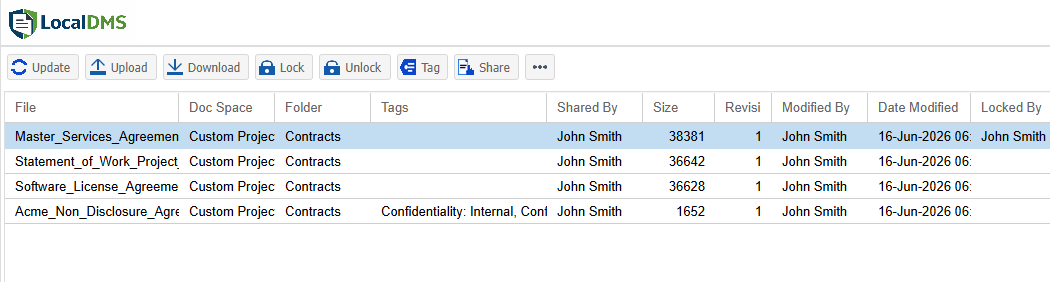
Document Spaces let a firm organize records by client relationship, advisor, or document type — keeping each client's agreements, IPS, correspondence, and account documentation together in one place, rather than split across a shared drive and an inbox. Full-text search means any document is retrievable in seconds by client name, date, or keyword, without needing to remember which folder it was filed in.
Version Control That Actually Holds Up
Every edit to a client agreement or IPS is retained as a distinct version with a timestamp and the identity of who made the change. Nothing is silently overwritten — the full history of a document is always available.
When a question comes up about which version of an agreement was in effect at a given date, or who approved a change, the answer is in the system — not dependent on someone's memory or an email search.
2. Correspondence and Communications Archiving
Client correspondence is often the hardest category of records to keep organized, since it accumulates continuously across email, meeting notes, and internal discussion. LocalDMS gives a firm a structured place to store and retrieve correspondence tied to a specific client or matter, searchable by keyword rather than relying on an email client's own search.
3. Built-In Electronic Signatures for Client Agreements
A free DocuSign alternative for RIAs, built into your document system.
Advisory agreements and disclosure acknowledgments can be signed directly within LocalDMS — a drawn signature plus identity re-authentication, logged with a timestamp as part of the approval step. There's no need for a separate e-signature subscription just to get a client's signature on an agreement — one less line item in your firm's technology stack.
4. Affordable for a Solo Practice or a Growing Firm
Compliance and content management platforms built for large asset managers are routinely priced out of reach for a solo RIA or a small advisory team. LocalDMS takes a different approach:
All licenses are perpetual — pay once, own it forever. There is no required annual renewal, though an optional 10% annual maintenance plan is available to stay on the latest version. A solo practitioner or a two-person advisory team runs on the Community Edition at no cost, indefinitely.
Who Uses LocalDMS as an RIA
- Solo RIA practitioners managing client agreements and correspondence without a back-office team
- Small multi-advisor RIA firms organizing shared client documentation across several advisors
- Fee-only financial planning practices maintaining IPS documents and suitability records
- Family offices keeping sensitive client and account documentation on infrastructure they control
- Breakaway brokers and breakaway RIAs transitioning from a broker-dealer and setting up document infrastructure for the first time as an independent firm
Getting Started
LocalDMS is available immediately — no sales process required for the Community Edition. Download the installer, deploy it on a server or workstation your firm already owns, and start organizing client documentation the same day.
For firms with more than 10 users, perpetual on-premises licenses start at $750 for up to 20 users. If you'd like to see how LocalDMS fits your firm's specific recordkeeping workflow, request a demo and we'll walk through it directly.
Frequently Asked Questions
What are the recordkeeping requirements for RIAs?
SEC-registered investment advisors are subject to the books and records requirements of Rule 204-2 under the Investment Advisers Act of 1940, which specifies which records must be kept, for how long, and how they must be stored. State-registered advisors are subject to similar recordkeeping rules set by their state securities regulator. LocalDMS does not certify compliance with any specific regulation — it provides version control, audit trails, and retention tools that support a firm's own recordkeeping program, which a firm's compliance counsel should evaluate against its specific obligations.
Can LocalDMS help an RIA organize Form ADV and client agreements?
Yes. LocalDMS provides organized, version-controlled storage for Form ADV filings, client advisory agreements, investment policy statements, and related documentation, with full-text search and role-based access so the current version is always easy to locate.
Is LocalDMS suitable for a small or solo RIA practice?
Yes. The Community Edition is free forever for up to 10 users, which covers most solo and small RIA practices at no cost. Larger firms can scale to perpetual licenses starting at $750 for up to 20 users.
Does LocalDMS keep client data on the advisor's own infrastructure?
Yes, for on-premises deployment. LocalDMS installs on a Windows server or desktop the firm already owns, and client documents remain on that infrastructure rather than a third-party cloud provider. A hosted SaaS option is also available for firms that prefer not to manage their own server.