The Document Control Challenge in Manufacturing
Manufacturing operations are built on controlled documents. Standard operating procedures define how processes are performed. Work instructions guide operators on the production floor. Quality records capture what was actually done and what results were achieved. Engineering specifications define what must be produced. Control plans define how conformance is verified. Safety data sheets protect workers from hazardous materials. And beneath all of these sits a requirement that has been embedded in manufacturing quality frameworks since the earliest days of ISO 9001: documents must be controlled.
Document control in manufacturing is not a back-office function — it is a direct operational requirement. When an operator on the production floor follows an outdated procedure because the current version was never distributed, the result is a nonconformance. When a quality record is missing, a customer audit finding results. When an engineering change is not captured in the controlled document set, the product may not conform to specification. The consequences of poor document control — rework, scrap, customer complaints, audit failures, and regulatory action — are direct and measurable.
Most manufacturing organizations operating without a dedicated document management system manage controlled documents through a mix of shared drives, printed binder systems, and email distribution — all of which fail the basic document control test: there is no reliable way to ensure that every operator, at every workstation, is using the current approved version of every document they need.
LocalDMS solves this problem with an on-premises document management system that provides the version control, approval workflows, access controls, and audit trails that manufacturing document control requires — starting free for teams of up to 10 users.
Manufacturing Document Types LocalDMS Controls
Standard Operating Procedures
Work Instructions
Engineering Specifications
Control Plans
Test & Inspection Records
Quality Records (DHR/DMR)
Safety Data Sheets (SDS)
Process Flow Diagrams
Product Specifications
Change Control Records
Training Records
Nonconformance Reports
Key Manufacturing Document Management Use Cases
SOP & Work Instruction Control
Version-controlled SOPs and work instructions with structured approval workflows ensure only current, authorized procedures reach the production floor — eliminating the outdated document problem.
ISO 9001 Document Control
LocalDMS directly satisfies ISO 9001 clause 7.5 requirements — version control, approval workflows, access controls, and audit trails provide the documented information control evidence auditors require.
Engineering Change Control
Manage the complete engineering change process — change requests, impact assessments, approval routing, and controlled document updates — with a documented, auditable change record for every revision.
Quality Records Management
Store inspection records, test results, batch records, and nonconformance reports in a structured, searchable repository with the long-term retention capability quality standards require.
Training Documentation
Maintain training materials, competency assessments, and training completion records linked to the controlled documents they cover — demonstrating that staff are qualified to perform the procedures they follow.
Supplier & Customer Documents
Organize supplier qualification records, approved supplier lists, customer-specific requirements, and external specification documents with version control and clear current-version identification.
1. ISO 9001 Document Control — Meeting Clause 7.5 Requirements
ISO 9001:2015 clause 7.5 (Documented Information) establishes clear requirements for how organizations must control their documented information. These requirements are the foundation of quality management system (QMS) document control, and they map directly to LocalDMS capabilities.
Creating & Updating
Documents must be identified, formatted, and reviewed/approved before use. LocalDMS version control and approval workflows satisfy this requirement — every document has an identifier, a version, and a documented approval before it is issued.
Availability & Suitability
Documented information must be available where needed, in a suitable format. LocalDMS browser-based access makes current approved documents available at any authorized workstation on the network — no printed binders to manage.
Protection
Documents must be protected from unauthorized modification and unintended use. LocalDMS role-based security restricts document editing to authorized personnel, and version control prevents unauthorized changes from overwriting approved content.
Distribution, Access & Retention
Requirements for controlled distribution, access control, storage, retention, and disposal. LocalDMS satisfies all of these through Document Spaces, role-based access, version history retention, and complete audit trails.
ISO 9001 specifically requires that obsolete documents be prevented from unintended use. In LocalDMS, superseded document versions are retained for historical reference but clearly marked as obsolete — production staff always see the current approved version, never an outdated one.
2. SOP and Work Instruction Document Control
The most operationally critical document control requirement in manufacturing is ensuring that production staff always follow the current, approved version of every SOP and work instruction relevant to their work. This sounds simple — but in practice, it is one of the most common sources of quality system failures.
The Outdated Document Problem
In a shared-drive or paper-based system, updating an SOP requires: creating the new version, getting it approved, distributing it to every location where it is used, and retrieving and destroying or marking all copies of the old version. In practice, old versions persist — in binders, in personal files, saved on local drives. The result is that operators may be following a procedure that was superseded months ago, and there is no reliable way to detect or prevent this.
LocalDMS Solves the Current-Version Problem
In LocalDMS, there is only one current approved version of each SOP or work instruction — clearly identified, accessible to authorized users from any workstation on the network, and automatically distinguished from all prior versions. When an SOP is revised and the new version is approved, it immediately becomes the version that production staff see when they access that document. The prior version moves to the version history — retained for reference and compliance purposes, but not accessible as the working document.
Controlled Issue and Distribution
The approval workflow in LocalDMS creates a controlled issue process for every document update. A revised SOP routes through defined reviewers — process engineering, quality, production management — with electronic sign-offs at each stage. Only after all required approvals are obtained does the new version become the current issued version. The complete approval chain is documented and permanently attached to the document.
When every production workstation accesses SOPs through LocalDMS, operators always see the current approved procedure. There are no paper binders to update, no old versions to hunt down, and no uncertainty about whether the procedure being followed is the current one.
3. Engineering Change Control
Engineering changes in manufacturing affect product specifications, production processes, tooling, materials, and quality control methods — often simultaneously. Managing the change control process requires tracking the change request, assessing the impact across all affected documents, routing the change for appropriate approvals, updating the controlled document set, and maintaining a complete record of what changed, why, and when.
Change Request Documentation
LocalDMS stores change request documentation — the description of the change, the justification, the impact assessment, and the list of affected documents — as controlled documents in their own right. Each change request has a document record with version history, so the evolution of the change through the approval process is traceable.
Coordinated Document Updates
When an engineering change affects multiple controlled documents — an SOP, a control plan, a work instruction, and a product specification all require updating — LocalDMS tracks each affected document through its own revision and approval cycle. Tags and categories link the updated documents to the change request that triggered them, providing a complete picture of all documentation affected by each change.
Effective Date Control
Engineering changes often have controlled effective dates — the change takes effect at a specific production date, batch number, or product serial number. LocalDMS metadata fields capture effective date information alongside the controlled documents, and the version history retains the prior approved documents for products manufactured before the change was effective.
4. Quality Records — Retention, Retrieval, and Audit Readiness
Quality records — inspection results, test data, batch records, nonconformance reports, corrective action records — are the evidence that quality processes were actually performed. In regulated manufacturing environments (FDA, automotive IATF 16949, aerospace AS9100), quality record retention requirements can extend to 10, 15, or even 30 years. In any quality system audit, quality records are the primary evidence auditors review to verify that the quality system is actually working.
Structured Quality Record Storage
LocalDMS organizes quality records in a structured repository — by product line, batch, inspection type, or any organizational structure that matches your quality system. Records are stored with metadata that makes them retrievable by multiple dimensions: all inspection records for a specific product, all nonconformance records in a date range, all corrective action records for a specific root cause category.
Full-Text Search Across Quality Records
When a customer complaint references a specific batch or lot number, when an internal audit requires all NCRs related to a specific process, or when a regulatory inspection demands all records related to a specific product — LocalDMS's full-text search retrieves the relevant records immediately. No manual folder searches, no spreadsheet cross-referencing, no risk that a record was misfiled and cannot be found.
Long-Term Retention on Your Own Infrastructure
Quality record retention requirements often exceed the lifespan of cloud-based software subscriptions. A vendor that discontinues a product or goes out of business takes your quality records with them. LocalDMS's on-premises deployment means quality records are stored on your own servers, under your control, with no dependency on a vendor's continued operation. Records retained for 15 years are as accessible on day 5,475 as they were on day one.
With LocalDMS, customer auditors and registrar auditors can be shown complete, organized quality records immediately — retrieved by product, date, process, or any combination. No scrambling to locate records across multiple systems before an audit.
5. FDA-Regulated Manufacturing and 21 CFR Part 11 Considerations
Manufacturers operating under FDA oversight — medical device manufacturers under 21 CFR Part 820, pharmaceutical manufacturers under 21 CFR Parts 210/211, and others — face document control requirements that go beyond ISO 9001. 21 CFR Part 11 establishes requirements for electronic records and electronic signatures in FDA-regulated environments, including requirements for audit trails, access controls, and system validation.
LocalDMS provides the foundational document control capabilities that FDA-regulated manufacturers need — version control, controlled approval workflows, role-based access, and complete audit trails. Organizations in FDA-regulated environments should work with their quality and regulatory teams to assess validation requirements and determine how LocalDMS integrates with their overall quality management system.
6. Affordable Manufacturing Document Control
Dedicated quality management system (QMS) platforms with document control modules — Veeva Vault, MasterControl, ETQ Reliance — are priced for large regulated manufacturers with enterprise budgets. For small and mid-size manufacturers, contract manufacturers, job shops, and component suppliers, these platforms are out of reach. LocalDMS delivers the core document control capabilities that manufacturing quality systems require at a price that works for any organization:
All licenses are perpetual — pay once, own it forever. For a small manufacturer with a quality team of 10 or fewer people, the Community Edition provides full document control capability at no cost. For a facility with 50 people involved in document control, quality records, and engineering documentation, the one-time $3,000 Business license delivers enterprise-grade document management at a fraction of what dedicated QMS platforms charge annually.
Who Uses LocalDMS in Manufacturing
- ISO 9001 certified manufacturers maintaining controlled document sets, quality records, and internal audit documentation for certification compliance
- Medical device manufacturers managing design history files (DHF), device master records (DMR), and quality system records under 21 CFR Part 820
- Automotive suppliers controlling IATF 16949 documentation — control plans, FMEAs, MSA studies, and customer-specific requirement documents
- Aerospace manufacturers managing AS9100 quality system documentation, first article inspection records, and customer approval documentation
- Food and beverage manufacturers managing HACCP plans, food safety procedures, supplier documentation, and regulatory compliance records
- Contract manufacturers organizing customer-provided specifications, traveler documentation, and job-specific quality records
- Electronics manufacturers controlling assembly procedures, IPC workmanship standards, and inspection records
- Chemical manufacturers managing safety data sheets, process safety documentation, and environmental compliance records
Getting Started with Manufacturing Document Control
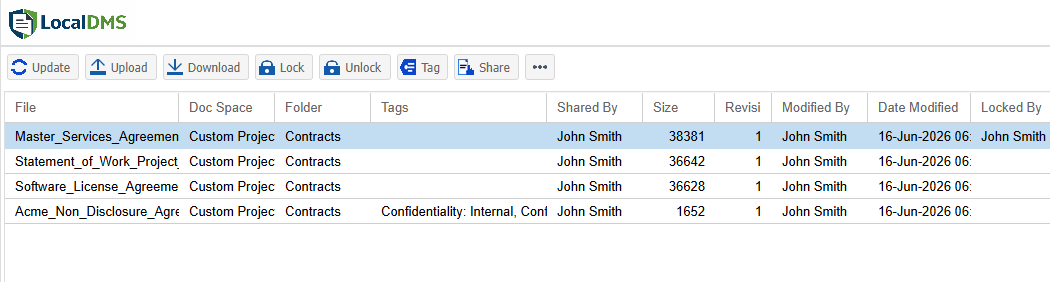
LocalDMS is available immediately — no sales process required for the Community Edition. Download the installer, deploy it on your Windows server, create your controlled document structure, and your quality team can begin managing SOPs, work instructions, and quality records with proper version control the same day.
For larger quality teams and multi-department deployments, perpetual on-premises licenses start at $750 for up to 20 users. For manufacturers requiring a hosted option for multi-site access, contact us for SaaS pricing. To see how LocalDMS document control would work within your quality management system, request a demo and we will walk through your specific use case directly.