Policy files
- Applications, quotes, issued policies, endorsements and renewals
- Version-controlled and searchable
Organize policy files, claims records, underwriting documents and producer files in a self-hosted repository — searchable by content, restricted by role, with every form revision kept.
LocalDMS is a self-hosted document management system that independent agencies, brokerages, MGAs and regional carriers use to organize policy files, claims files, underwriting documents, producer records and regulatory filings. Documents are full-text searchable, access is limited by role, and each revision and approval is recorded. It is free for up to 10 users, with perpetual licenses from $750.
Last updated
LocalDMS at a glance
| Deployment | Self-hosted on your own Windows desktop or server (Windows Server 2016 or later), or hosted SaaS by subscription |
|---|---|
| Access | Any modern web browser — no client software to install |
| Search | Full-text search of document content; built-in OCR for scanned files in 100+ languages |
| Version control | Every update is stored as a new revision; earlier revisions are kept |
| Reviews & approvals | Assign reviewers and approvers; decisions and comments stay with the document |
| Access control | Role-based permissions by Document Space and folder |
| Activity log | Records document operations; cannot be edited, even by administrators |
| Import & export | Upload multiple files at once; export data through a REST API |
| Licensing | Concurrent sessions, not named users; perpetual on-premises licenses |
| Price | Free for up to 10 users; perpetual licenses from $750 — see pricing |
Insurance is a document business: every policy, claim, appointment and filing produces records that must be found again years later.
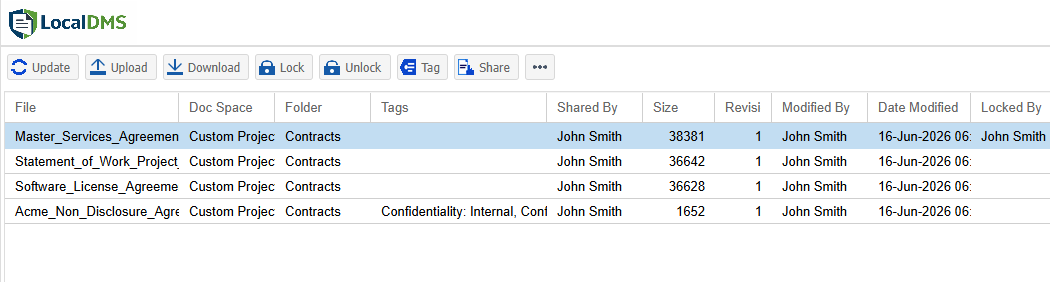
Each revision of a form is kept with its history. When a claim arises under a policy issued on an older form, that version can be retrieved from the revision history.
Folders and tags keep endorsements with the policy they modify, so the base policy and its changes are read together.
Application, binding, issuance, endorsements, renewals and cancellation documents sit in one policy file.
An incomplete claims file creates risk at every level: slower resolution for the customer, weaker claims decisions and exposure if the record cannot be produced.
FNOL report, adjuster notes, estimates, photographs, correspondence, expert reports and settlement documents are organized together.
Search by claim number, claimant name, policy number or any term in the documents. Scanned items are included through built-in OCR.
Revision history shows how documents changed. The activity log records document operations and cannot be edited, even by administrators.
Each state insurance department has examination and market-conduct authority, and requests can cover several operational areas at once. LocalDMS does not certify compliance with any state requirement; it keeps the documentation organized and retrievable.
Claims-handling procedures, market-conduct policies, privacy notices and anti-fraud plans, each with a revision history and approval record.
Training records, monitoring documentation and termination records kept in each producer's file.
State filings organized by state, type and effective date, with department inquiries and responses stored alongside.
| Factor | Shared drives, email & paper | LocalDMS |
|---|---|---|
| Where files live | Shared drives, email archives and paper files | One repository with spaces for policy, claims and compliance |
| Finding a document | Browsing folders and inboxes | Full-text search of content, plus file names and tags |
| Scanned paper | Not searchable | Searchable through built-in OCR |
| Current version | Several uncontrolled copies | Latest revision shown; earlier revisions kept |
| Approvals | Email chains and paper routing | Reviews and approvals recorded with the document |
| Access control | Broad or inconsistent folder access | Role-based access by Document Space and folder |
| Accountability | Little visibility into changes | Revision history and an activity log that cannot be edited |
An independent agency with up to 10 staff runs on the free Community Edition. An MGA or regional carrier team of 20 pays a one-time $750.
On-premises licenses are perpetual: pay once and the license does not expire. An optional maintenance plan (10% of the license price per year) keeps you on the latest version. All editions have the same features and differ only by user count, and licenses count concurrent sessions rather than named accounts.
All features. No credit card. No expiry date.
LocalDMS gives insurance organizations one on-premises repository for policy files, claims records, underwriting documents, producer agreements, compliance policies and regulatory correspondence, with version control, full-text search, role-based security and approval workflows.
Policy applications and endorsements, claims files and adjuster notes, underwriting guidelines, agent and broker agreements, producer licensing records, compliance policies, state filing documentation, E&O records, reinsurance agreements and customer correspondence.
LocalDMS keeps version histories and approval records for compliance documents and makes them searchable, which shortens the time needed to respond to an examination request. It does not certify compliance with state insurance regulations.
Yes. Independent agencies, brokerages and MGAs use it for organized, searchable document management without an enterprise software budget. The Community Edition is free for up to 10 users.
No. LocalDMS manages documents. It works alongside the agency management or policy administration system that holds your policy and client data.
LocalDMS is free for up to 10 users. Perpetual on-premises licenses cost $750 for up to 20 users, $3,000 for up to 50 users and $5,000 for up to 100 users, with custom Enterprise pricing above 100 users. Licenses do not expire, and an optional maintenance plan (10% of the license price per year) keeps you on the latest version. Hosted SaaS is priced separately.
Start free on your own server, or request a demo built around your policy and claims files.