The Document Control Challenge in Construction and Engineering
Construction and engineering projects are among the most document-intensive endeavors in any industry. A single commercial construction project can generate thousands of documents — architectural drawings, structural calculations, mechanical and electrical specifications, geotechnical reports, RFIs, submittals, shop drawings, inspection reports, change orders, safety records, and contracts. On an infrastructure or capital project, that number can reach tens of thousands.
The stakes of poor document management in this industry are uniquely high. A contractor working from a superseded drawing can install systems that must be demolished and rebuilt — directly adding cost and schedule impact. A missed RFI response can result in field work proceeding on incorrect assumptions. A lost inspection record during a regulatory audit can jeopardize project certification. A change order that cannot be located becomes a claims dispute.
Most construction document control problems have the same root cause: documents distributed by email, stored on personal drives or unstructured shared folders, with no version tracking, no access control, and no audit trail. Everyone on a project team may be working from a different version of the same drawing, with no mechanism to ensure currency.
LocalDMS provides a practical, affordable solution: a centralized document repository with version control, structured folder organization, full-text search, approval workflows, and role-based access — deployed on your own servers, starting free for teams of up to 10 users.
Construction and Engineering Document Management Use Cases
Drawing & Specification Management
Maintain current and superseded revisions of all project drawings and specifications in a structured, searchable repository with clear revision history.
RFI Tracking & Response Records
Store RFI submissions, responses, and formal clarifications with full version history, ensuring all parties work from the current interpreted design intent.
Submittal Review & Approval
Route shop drawings and product submittals through structured review workflows, capturing reviewer sign-offs and tracking approval status across the project.
Change Order Documentation
Manage the full change order record — scope descriptions, supporting documentation, pricing, and executed change orders — in a structured, retrievable repository.
Safety & Inspection Records
Store method statements, safety plans, inspection reports, and non-conformance records with version control and role-based access for regulatory compliance.
Project Closeout & As-Built Records
Organize the complete project closeout package — as-built drawings, O&M manuals, warranties, and commissioning records — in a structured handover repository.
Document Types LocalDMS Manages in Construction and Engineering
Architectural Drawings
Structural Calculations
MEP Specifications
RFIs & Responses
Shop Drawing Submittals
Change Orders
Inspection Reports
Safety Plans & JSAs
Subcontractor Agreements
Method Statements
Testing & QA Records
O&M Manuals
1. Drawing and Document Version Control
Version control is the single most critical document management requirement in construction and engineering. When multiple drawing revisions exist for the same element, every team member — architects, engineers, contractors, inspectors — must be able to identify the current approved revision instantly and access prior revisions when needed for reference or claims purposes.
Automatic Revision Tracking
Every document stored in LocalDMS is versioned automatically. For construction drawings, this means every revision — from preliminary design through issued-for-tender, issued-for-construction, and final as-built — is retained with a complete history. The current revision is always clearly identified. Prior revisions are retained and clearly marked as superseded, retrievable at any time for reference, dispute resolution, or claims substantiation.
Eliminating the Superseded Drawing Problem
The most costly document management failure in construction is work executed from superseded drawings. When the current drawing revision is always clearly identified in LocalDMS and all prior revisions are marked as such, this risk is substantially reduced. Every team member with system access can confirm they are working from the current approved document — from the site office or the field.
Supporting Claims and Dispute Resolution
Construction disputes frequently turn on document history: what drawing was in effect on a given date, what the RFI response said, what change order scope was agreed upon, and when specific approvals were given. LocalDMS's version history and audit trail provide a complete, timestamped documentary record of every document at every point in the project lifecycle — the evidentiary foundation for claims resolution and litigation support.
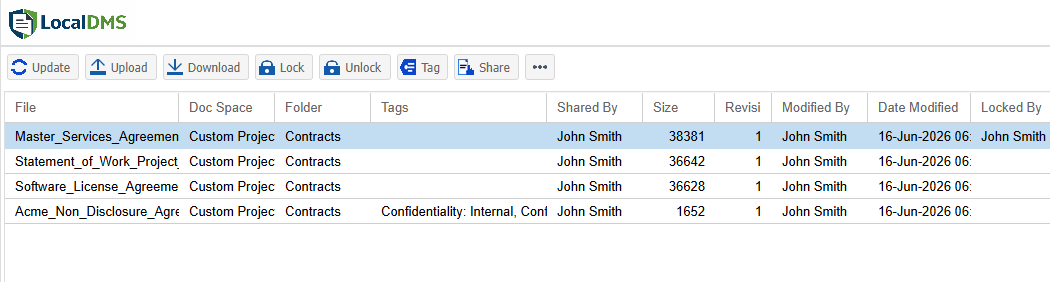
In LocalDMS, the current approved version of every document is always clearly identified. Superseded revisions are retained but marked as such — eliminating the confusion of multiple drawing revisions circulating via email or saved to individual drives.
2. Submittal and RFI Workflow Management
Submittals and RFIs represent two of the highest-volume, highest-stakes document workflows in construction project management. A submittal backlog or delayed RFI response can directly cause field work to stop. A lost or undocumented RFI response creates scope ambiguity that generates change order disputes. Managing these workflows through email is a recipe for delays, lost items, and unresolved ambiguity.
Structured Submittal Review Routing
LocalDMS routes submittal packages — shop drawings, product data, samples documentation — through defined review sequences. A structural submittal routes to the structural engineer of record; an MEP submittal to the mechanical or electrical engineer; a finish submittal to the architect. Each reviewer receives a notification when the submittal requires their attention, provides their review comments and approval or rejection, and the decision is captured with a timestamp and electronic sign-off.
RFI Documentation and Response Records
Store RFI submissions, formal responses, and any referenced clarification sketches or supplemental documents as a complete, organized record. Every RFI has a clear status — open, responded, closed — and the full document thread is retrievable at any time. When a field condition arises that references a prior RFI response, the answer is immediately available to the site team.
Full Audit Trail for Every Workflow Item
Every submittal review action and RFI response is logged with the reviewer identity and timestamp. This creates a complete, auditable record of the project's formal documentation workflow — who reviewed what, when, and what decision was made. In a claims or dispute context, this record is invaluable.
Every submittal and RFI in LocalDMS has a clear status, a complete document record, and a logged review trail. Nothing gets lost in someone's inbox or buried in an email chain.
3. Project-Based Organization and Access Control
Construction firms typically manage multiple projects simultaneously, each with its own team, its own document set, and its own access requirements. Subcontractors and consultants may need access to specific project documents but must be kept out of others. Sensitive commercial documents — contracts, pricing, claims correspondence — must be restricted to authorized personnel.
Project-Level Document Spaces
LocalDMS's Document Spaces allow each project to be isolated as its own controlled environment. Each project space has its own folder structure, its own user access list, and its own permission settings. The project team for Project A cannot access the documents for Project B unless specifically authorized. Sensitive commercial files can be further restricted within a project space to specific roles.
Discipline-Based Folder Structures
Within each project, folder structures can be organized by discipline — architectural, structural, civil, mechanical, electrical — and by document type — drawings, specifications, correspondence, contracts, reports, and closeout. A consistent structure across all projects means every team member knows exactly where to find and file any document type, regardless of which project they are working on.
Role-Based Access for Subcontractors and Consultants
External parties — subcontractors, specialist consultants, inspection bodies — can be given access to specific document spaces or folders within LocalDMS without granting them access to the full project repository. A structural subcontractor sees the structural documents relevant to their scope. A mechanical consultant accesses MEP specifications and their submittal log. Access is defined precisely and updated immediately when the project team composition changes.
4. Safety, Quality, and Regulatory Compliance Records
Construction and engineering projects operate under extensive safety and quality regulatory requirements — OSHA regulations, local building codes, environmental permits, and quality management standards including ISO 9001. Document management is central to demonstrating compliance with all of these frameworks.
Safety Documentation
Method statements, job safety analyses (JSAs), toolbox talk records, incident reports, and inspection certifications all require organized, accessible, and version-controlled storage. In the event of an OSHA inspection, an incident investigation, or a regulatory audit, the ability to produce the current safety documentation immediately is both a legal requirement and a practical necessity. LocalDMS provides that capability.
ISO 9001 Document Control
For engineering firms operating under ISO 9001 certification, document control is a core quality management requirement. ISO 9001 clause 7.5 requires that documented information be controlled — available where needed, adequately protected, and with obsolete versions prevented from unintended use. LocalDMS satisfies these requirements through version control, access management, and clear identification of current versus superseded document versions.
Inspection and Testing Records
Concrete pour records, weld inspection reports, material test certifications, and commissioning documentation all constitute quality records that may be required years after project completion for warranty claims, building certifications, or regulatory inquiries. LocalDMS retains these records indefinitely with their full version history and access log, organized within the project file for retrieval at any future point.
LocalDMS supports ISO 9001 clause 7.5 document control requirements — version control, approval workflows, access management, and prevention of obsolete version use — out of the box, without additional configuration.
5. Project Closeout and Long-Term Record Retention
Project closeout is the most document-intensive phase of construction — and the most frequently mismanaged. As-built drawings, operation and maintenance manuals, warranty documentation, commissioning reports, test records, and regulatory certificates must all be organized, reviewed, and handed over to the building owner or operator in a complete, organized package.
LocalDMS allows firms to build the closeout package progressively throughout the project, organizing as-built documentation as it is produced rather than scrambling at project completion. The closeout Document Space can be structured to match the owner's handover requirements — making the formal handover a matter of granting access rather than assembling documents from scratch.
Beyond handover, construction records have long retention requirements — typically 10 years or more for structural records, longer for infrastructure projects. LocalDMS stores records indefinitely on your own infrastructure, with no subscription that could expire and terminate access to historical project records.
6. Affordable Construction Document Management — Without Enterprise Pricing
Enterprise construction project management platforms — Procore, Aconex, Newforma — are powerful tools built for large general contractors and owner organizations with correspondingly large technology budgets. For small and mid-size contractors, specialty subcontractors, engineering consultancies, and owner project management teams at non-enterprise organizations, those platforms are prohibitively expensive.
LocalDMS delivers the core document management capabilities that construction and engineering organizations actually need — version control, organized project repositories, approval workflows, full-text search, and role-based access — at a price that makes deployment practical for firms of any size:
All licenses are perpetual — pay once, own it forever. No annual renewal fees, no per-user monthly charges. For a small specialty subcontractor or engineering consultancy with 10 or fewer project staff, the Community Edition is completely free. For a growing firm with 20 people managing project documents, the one-time $750 Professional license costs less than a single month of an enterprise construction document management platform.
LocalDMS vs. Enterprise Construction DMS Platforms
| Capability | LocalDMS | Enterprise Construction DMS (Procore, Aconex) |
|---|---|---|
| Free tier | ✓ Free for up to 10 users | ✗ No free tier |
| Perpetual license | ✓ One-time, no renewals | ✗ Annual subscription |
| On-premises deployment | ✓ Primary deployment model | ✗ Cloud-only |
| Document version control | ✓ Included | ✓ Included |
| Approval workflows | ✓ Included | ✓ Included |
| Full-text search | ✓ Included | ✓ Included |
| Role-based access | ✓ Included | ✓ Included |
| Native drawing viewer | ✗ Not included | ✓ Included |
| Scheduling integration | ✗ Not included | ✓ In most platforms |
| Mobile field access app | ✗ Browser-based only | ✓ Native mobile apps |
| Entry-level annual cost | ✓ $0–$750 one-time | ✗ $5,000–$50,000+/year |
Who Uses LocalDMS for Construction and Engineering Document Management
- Small and mid-size general contractors managing project document sets, subcontractor agreements, and compliance records across multiple active projects
- Specialty subcontractors organizing their scope-specific document sets, submittal packages, and as-built records
- Engineering consultancies managing calculation packages, drawing sets, project correspondence, and ISO 9001 quality records
- Owner project management teams organizing project documentation received from contractors and maintaining long-term facility records
- Architecture firms managing design documentation, client correspondence, contractor submittals, and project archives
- Infrastructure and utility organizations maintaining asset documentation, inspection records, and maintenance history
- Environmental and geotechnical consultancies managing site investigation records, laboratory reports, and regulatory submissions
- Facilities management teams organizing O&M documentation, maintenance contracts, and asset records for occupied buildings
Getting Started with Construction Document Management
LocalDMS is available immediately — no sales process required for the Community Edition. Download the installer, deploy it on your Windows server, create your project folder structure, and your team can begin organizing documents the same day. For small contractors, consultancies, and project teams of 10 or fewer, the Community Edition provides all core document management capabilities at no cost, indefinitely.
For larger organizations managing multiple concurrent projects, perpetual on-premises licenses start at $750 for up to 20 users. For firms requiring a hosted option — particularly for multi-office or multi-site access — contact us for SaaS pricing. To see how LocalDMS would fit your specific project document workflows, request a demo and we will walk through your use case directly.